Key takeaways
- A white-label job has four stages: brief, access, attendance and handover.
- Most problems are decided in the brief and the access request, not on the floor.
- The engineer works to your process and reports to you. The facility will still need their real name and employer.
- The handover report is the product your customer actually sees. Agree its format first.
Earlier in this series we covered what white-label IT is, what to hand off and what to keep, and when overflow delivery makes sense. This guide follows a single job through its stages, using the two most common kinds of white-label work: smart hands and rack and stack.
Two kinds of job
Smart hands is scoped on-site support: replacing a failed component you or the vendor supplied, re-seating or tracing cabling, or looking at a device and telling you what is actually happening. If you are not sure where the line sits, our guide to remote hands versus smart hands explains it.
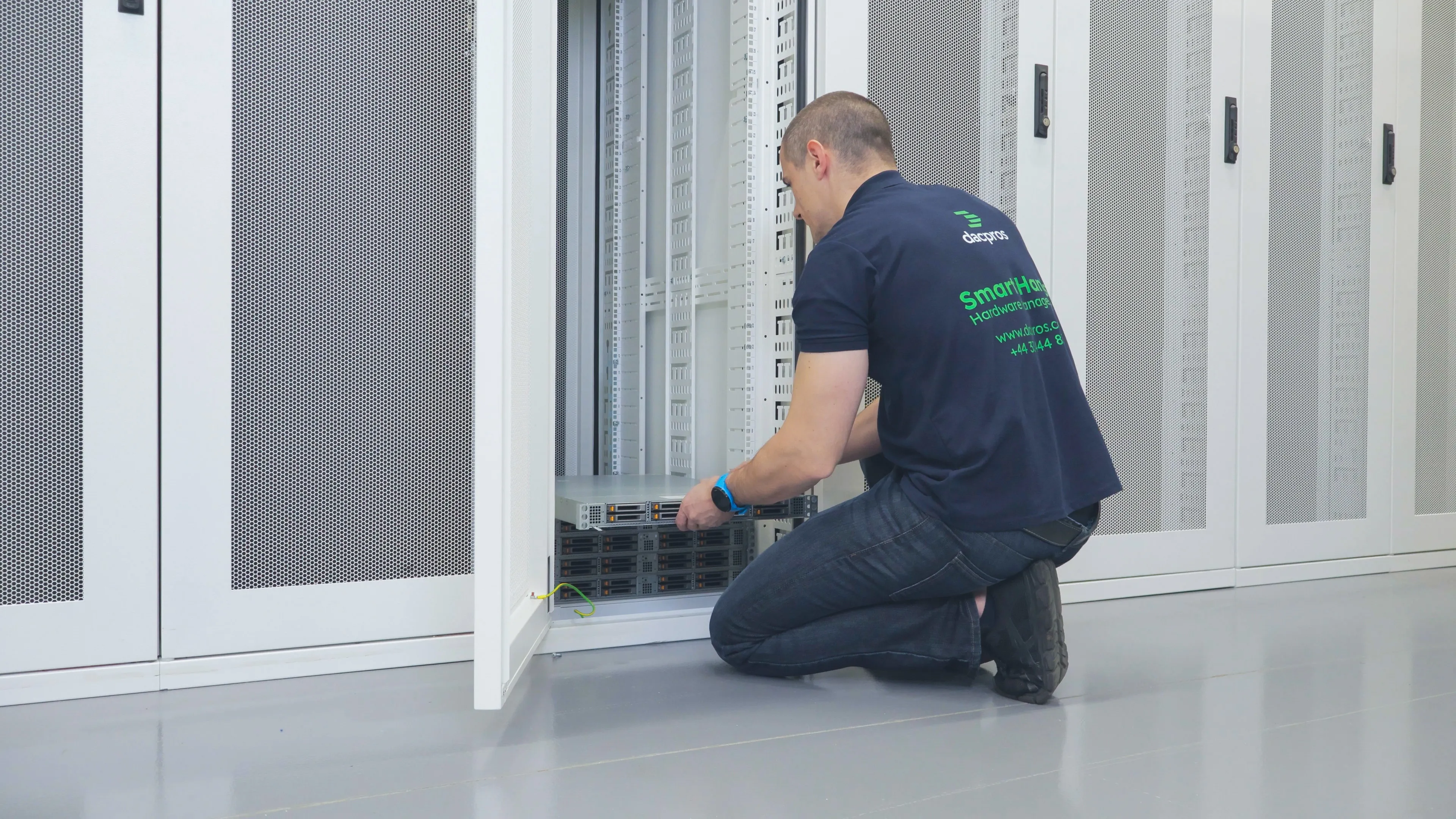
Rack and stack is a planned installation: mounting new equipment, connecting power and network, labelling and testing. It needs more preparation, and the preparation is where most of the quality comes from.
Both can be delivered under your name. The four stages below apply to each.
Stage 1: the brief
The brief is the single most useful document in the job. It should state the site, the equipment, who supplies each part, the window, the runbook, what done looks like, who to call if reality does not match the plan, and what the report must contain. The full list is in our guide to what to hand off and what to keep.
For rack and stack, add the design: rack positions, cable lengths, labelling convention and power allocation. Our rack and stack checklist lists what to prepare. If kit is arriving at the site, include the delivery details, so the engineer can reconcile what is there against what you ordered.
Stage 2: access
The facility decides who can enter. That is true whoever is holding the contract, and it is the point where “under your name” meets the real world.
- Who raises the request? Usually you or your customer, depending on who holds the relationship with the facility.
- What does the facility need? Typically the engineer’s real name, employer and identification, plus the work to be done and the time window.
- How long does approval take? It varies by facility. Ask early and do not leave it to the day before.
- What are the site rules? Some restrict photography, tools, packaging or visits outside set hours.
Settle with your customer how the arrangement is described, so nobody is surprised when the visitor record shows a different company name.
Stage 3: attendance
On the day, the engineer works to your runbook. For a rack and stack job, a sensible sequence is:
- Arrive and check. Confirm the equipment against the delivery paperwork and record serial numbers.
- Install. Mount, power and cable to the design.
- Label. Label cabling and equipment as agreed, so the result can be read by someone who was not there.
- Test. Check power, links and anything else the brief lists.
- Record. Capture what was done, with photographs where the site allows.
For a smart hands job the steps are shorter, but the habit is the same: do the scoped task, check it worked, record what you saw, and stop. If what the engineer finds does not match the brief, they should call the escalation contact you named and wait, not improvise.
If the job includes operating system installs or network configuration, decide in the brief who does it and who holds the credentials. Keeping privileged access with your own team, and having the engineer work to your instructions, is often the safer route.
Stage 4: the handover report
Your customer will not see the floor. They will see the report. That makes it the part of the job most worth designing.
A useful handover report covers:
- What was done, in the order it was done.
- Equipment touched, with serial numbers and locations.
- Port maps and labelling, so the work can be maintained later.
- Exceptions, meaning anything that differed from the brief, and what was decided.
- Evidence, such as photographs where permitted.
- Open items, so nothing is lost between the visit and your next action.
Agree the format before the first job, so the report can go to your customer under your name with minimal editing. If you want to discuss the format, we are happy to work from your template.
What stays outside the job
A few things sit outside a typical white-label smart hands or rack and stack job. Warranty-backed break/fix and hardware maintenance that needs parts to be sourced remain with you or the vendor. Recycling, disposal and certified data destruction are handled by specialist partners. Attendance is scheduled Monday to Friday, 09:00 to 17:00, and out-of-hours work needs arranging in advance, with no guaranteed response time. Knowing this at the start of a job costs nothing. Finding out partway through can cost you your customer’s trust.
Start with a small job
The easiest way to find out whether the arrangement suits you is to run one small job through all four stages. Tell us about a site or read more about our white-label IT service.