Key takeaways
- “Data centre services” is several different kinds of work. Decide which one you need before you compare providers.
- Three kinds of provider cover most of it: the colocation operator, an independent engineering provider, and a managed service provider. They are good at different things.
- Compare providers by giving each the same written brief and judging the answers on method, evidence and honesty about limits, not on price alone.
- A good provider tells you plainly what it does not do, including its hours of cover and what it hands to partners.
Searching for the best data centre services company in the UK produces directories and listicles, because the question is too broad to have one answer. A company that is excellent at running colocation space may not be the right choice to decommission a hundred servers, and an engineering team that is ideal for a rack build may not run your monitoring.
This guide does not rank providers. It sets out what data centre services cover, which kind of provider fits which job, and eight questions that make any provider easy to compare. If your job is specifically a rack build, our guide to choosing a rack and stack provider goes into more depth.
What data centre services cover
The phrase covers at least four separate things.
- Facility services. Space, power, cooling, connectivity and physical security. These come from the colocation or data centre operator.
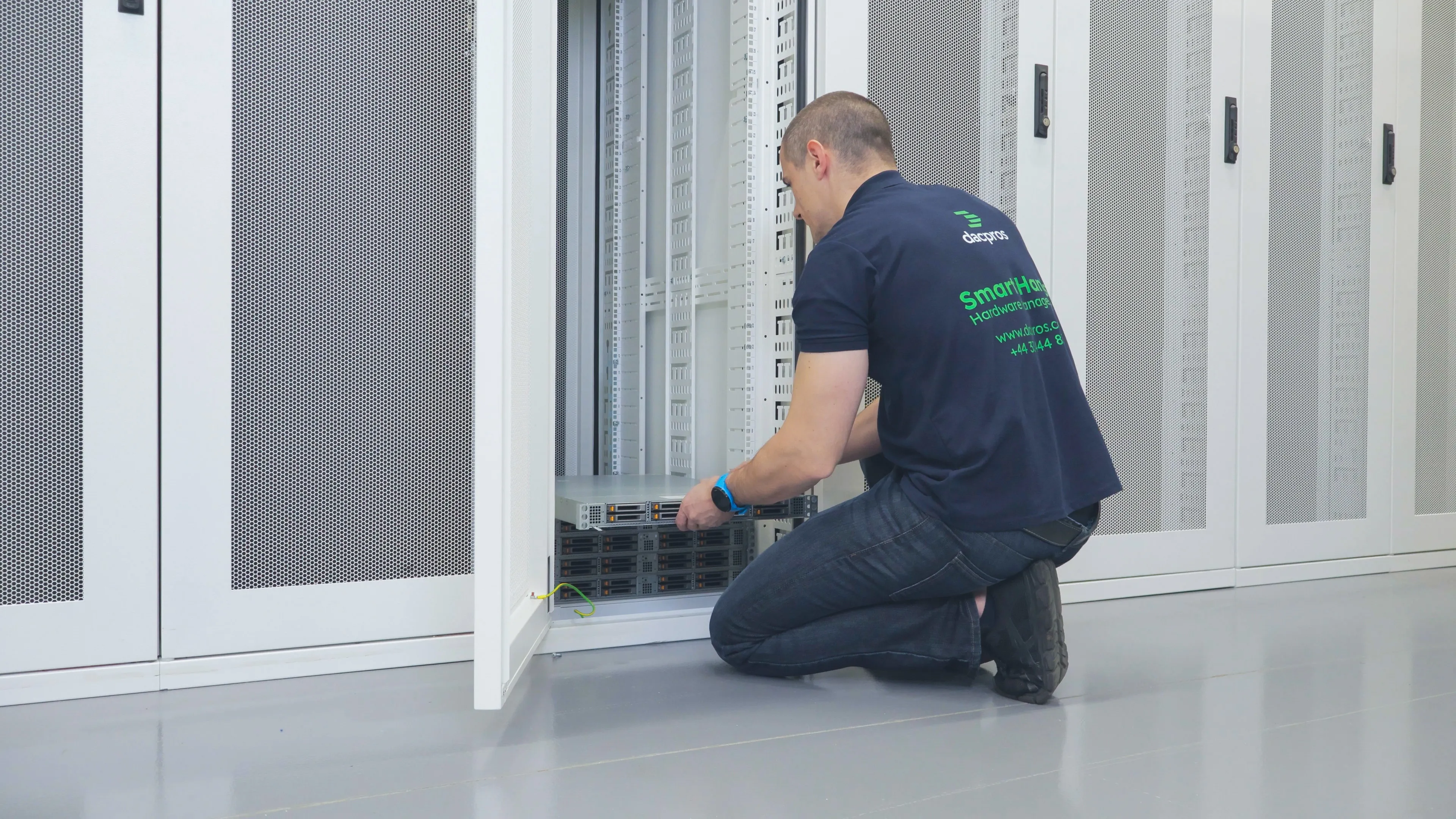
- On-site engineering. Work done by a person at your equipment: smart hands, remote hands, rack and stack and build and deployment, moving infrastructure between sites, RMAs and hardware replacement, and IT decommissioning.
- Managed services. A provider runs part of your environment for you, such as monitoring, operating systems or networks, usually under a contract with defined service levels.
- Equipment disposal. Data destruction, recycling and resale once equipment has left the rack. This is a specialist job, and most engineering providers hand it to a partner.
Most buying mistakes come from treating these as one thing. A provider that is strong in one area can be silent about the others, so ask which of them a quote actually includes.
Which kind of provider for which job
| Job | Often a good fit |
|---|---|
| Space, power, cooling, connectivity | The colocation or data centre operator |
| A reboot, a cable re-seat or a visual check at a site you do not want to travel to | The operator’s remote hands, or an independent engineer |
| A planned build, with cabling, configuration and a handover pack | An independent engineering provider |
| Moving equipment between sites | An independent engineering provider with a written sequence |
| Retiring a rack of servers | An engineering provider for the removal, plus a specialist partner for data destruction and recycling |
| Running monitoring, operating systems or networks on your behalf | A managed service provider |
| Extra field capacity when your own engineers are booked | An independent engineering provider working under your name |
Services, hours and charges vary by provider, so read the terms. The operator’s own team is convenient and already on the floor. An independent engineer brings consistency across facilities and a documented method. A managed service provider takes on responsibility that the other two do not. Our guide to remote hands vs smart hands explains one of the most useful distinctions: whether you supply the steps or the engineer supplies the judgement.
Eight questions to ask any provider
Put the same questions to each provider you are considering and compare the answers side by side.
- Can your engineers get into my facility? Facilities control who is allowed on the floor. Ask which sites the provider already attends and how long approval takes for a new one.
- Who will actually attend? Ask about the engineer’s experience with your hardware, and whether the person on site is the person who planned the job.
- Is the work instruction-led or judgement-led? Be clear about whether you supply exact steps or expect the engineer to diagnose and decide. The price and the risk differ.
- What are your hours of cover, stated plainly? Ask for working hours and what happens outside them. Be cautious of any claim of round-the-clock cover or a guaranteed response time that is not written into the terms.
- What will I have at the end? For builds, ask to see a sample handover pack: as-built records, port maps, asset list with serial numbers, test results and photographs.
- What do you do yourselves, and what do partners do? Data destruction, recycling and resale are often handled by a certified partner. That is fine, but you should know who is responsible for what and what paperwork you keep.
- How do you control change? Ask how a plan, a window and a scope change are agreed and recorded before work on live equipment.
- What happens when something goes wrong? Ask for a named point of contact, the escalation route if the engineer on site cannot resolve a problem, and how you report an issue after the visit.
What to be wary of
- Answers that avoid limits. A provider that cannot tell you what it does not do is hard to hold to a scope.
- Quotes with no written scope. A price that does not say what is included cannot be compared.
- Cover claims you cannot find in the terms. If 24/7 attendance or a fixed response time matters to you, ask for it in writing.
- Disposal described vaguely. Ask who handles data destruction and what certificate or record you will receive.
- No example of the output. If a provider cannot show a handover report or a sample record, you may not get one.
How DACPROS answers these questions
DACPROS provides on-site engineering: smart hands, remote hands, rack and stack, moves, RMAs and IT decommissioning. We are not a colocation operator, so we do not sell space or power. Data destruction and recycling are delivered through a partner, and we hand equipment over to that partner. Our operating hours are Monday to Friday, 09:00–17:00, and we do not offer a guaranteed response time.
DACPROS works from a hub in Hammersmith, London, and attends data centres across the UK, including facilities such as Telehouse, Equinix, Global Switch, Interxion, VIRTUS and Pulsant. Attendance is scheduled according to location, scope and engineer availability, and out-of-hours visits may be available when arranged in advance. DACPROS lists CompTIA A+, CDCMP, PRINCE2 and ITIL among its engineer accreditations.
For worked examples of how the work runs, see the cabinet build and L3 support case study, the London data centre migration and the 300-server decommissioning. If you are comparing providers, send us the brief on our contact page and we will tell you plainly whether the job is a fit.